By Kat Mulligan
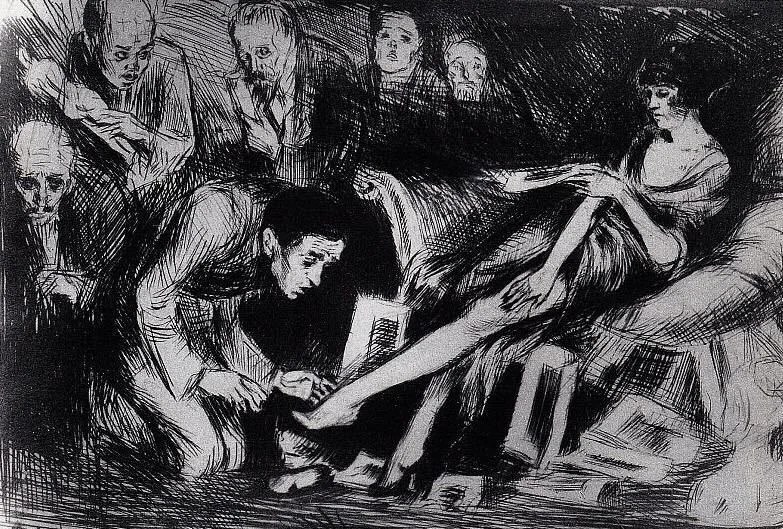
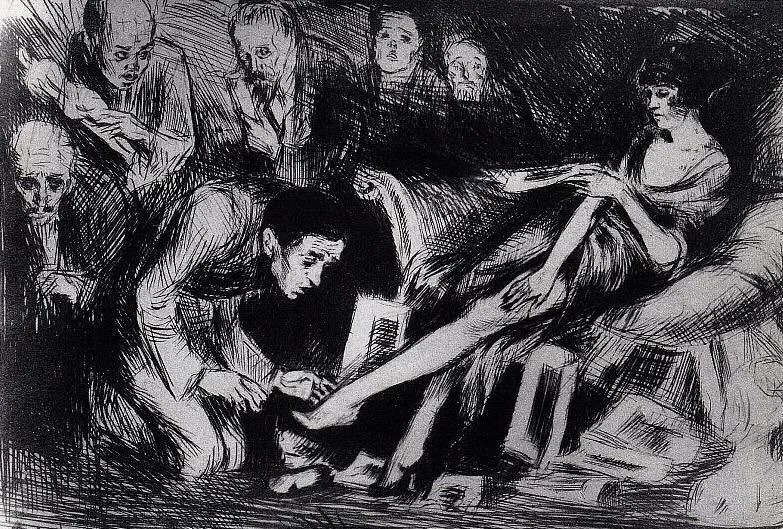
“Undula Visits the Artists,” by Bruno Schulz via Culture.pl, https://culture.pl/en/article/buried-treasure-a-new-story-by-bruno-schulz-unearthed.
Night after enduring night, I liberated myself to the streets which were irritated with months’ worth of ice. To Rachmaninoff preludes and Tchaikovsky ballets, I milled around the city in contemplation, extracting loose scraps of poetry from every stately building and hurried pedestrian. Even as I played the role of the tortured artist, with my cheeks rouged to a consumptive glow by the harsh Montreal wind and a scowl embittering my lips as a result, I could not have been more invigorated. After having suffered the weight of many winters’ numbnesses, I had finally discovered this time around the secret to surviving the earth’s least popular season: you must resign yourself to its claws.
With my summer spent in a constant state of socialization and my autumn spent winding down and trying my hand at love, by the winter I had returned to what I always knew—symmetry is the stuff of pleasure, and for my many months of elation I had to balance the scales. Whether or not we like to admit it, beauty exhausts us in time; winter arrives to alleviate this pressure. In spiritual hibernation, unobserved, we become familiar with ourselves again.
This talk of seasonal transition brings me to Bruno Schulz, who, by cruel design, has not lived to see these winters, springs, summers, and autumns of which he has aided my enjoyment. Bruno Schulz was a Polish-Jewish artist and writer, one of the three titans of the Polish literary avant-garde of the twentieth century, whom I discovered on Goodreads while in the throes of a Polish literature craze. Often named the Polish Kafka (although many scholars and readers alike, myself included, hesitate to adopt this title), he was known for his slim body of short fiction work, in which a sole protagonist named Joseph hops from story to story, navigating a variety of ages and fantastical scenarios. A theme I have been turning over in my head since my first read of his work is his concept of material metamorphosis.
Schulz’s writing is characterized by a deep reverence for all matter, whether constructed into living beings or inanimate objects. This reverence stems from his idea that all matter undergoes a constant metamorphosis in order to return to its metaphysical essence. Matter is perfect, and it is merely the forms that portray it that are inadequate. Therefore, this distortion is a necessary process in the laying bare of our surroundings. In “Essay for S.I. Witkiewicz,” Schulz explains that, “the substance of that reality exists in a state of constant fermentation, germination, hidden life. It contains no dead, hard, limited objects. Everything diffuses beyond its borders, remains in a given shape only momentarily, leaving this shape behind at the first opportunity… This migration of forms is the essence of life” (Letters, 113).
Since all matter is subject to change, can we not also say that the seasons undergo this very same metamorphosis? After the cold of winter relents, in comes spring; it is the same earth, only wearing a different face. Its form, in varying states, is a shroud thrown over an unchanging core.
The geographical location also determines the face a season wears. Spring in Canada is a trial wholly unlike that of spring in Virginia, where I grew up. My best friend once told me that I, a March baby, was born in winter—but where I’m from, my birthday was always the herald of spring, when we would flock to the outdoors and recognize an otherworldly optimism rolling in from out of town. Spring here, on the other hand, lasts only a few weeks and follows a tug-of-war between the clouds and the sun, where one feels as though they are stumbling through a tunnel whose end merely suggests light. It is as if winter were stubbornly bleeding out onto the land that its knuckles are whitening around.
With Canadian spring feeling more like a concept than a reality, we could liken it to a subdivision of Schulz’s metamorphic matter. Not only are tangible forms given reverent attention, but so are what Schulz names pseudo-flora and pseudo-fauna. One cannot touch these things of second-order creation and they are liable to be missed by distraction, but they are all the more essential in maintaining the organism of our world. These are the “old apartments saturated with the emanations of numerous existences and events; used up atmospheres, rich in the specific ingredients of human dreams; rubbish heaps, abounding in the humus of memories, of nostalgia, and of sterile boredom” (Tailors’ Dummies, 37). Pseudo-flora and pseudo-fauna also belong to the metamorphosis that Schulz describes. As quickly as the moonlight strains through the battered roof of a farmhouse and inspires awe, so does it, too, vanish into the black clot of night.
Next, summer arrives, and unmistakably—in full force, like a tangible object. As was the case in winter, I set my mind to following the tenets of this more attractive season. I swam in the river under a willow tree until a Jean Drapeau park ranger reprimanded me for my indulgence; I pirouetted around NDG and served lemon posset on my balcony; I chased my friends to the swing set at midnight as my mouth brimmed with laughter. The trick, though, about summer—which, as it turns out, is not the case for winter—is that to resign oneself to the season is to live in unawareness and folly. Our hibernal period of contemplation is over. The soul abounds without thinking why or how.
Despite the unique sluggishness of spring and the seemingly inexorable snow showers innate in Montreal, our planet knows how to arrange itself in proper doses. The seasons come at the right time. Too much summer seduces the soul into distraction, too much winter drowns it. In our particular geographical location, we have four even, bite-sized slices of atmosphere to chew on until full. How would we orient ourselves otherwise? A wet and dry season is not enough for someone like me, who chronicles time through the environment. We must watch things die in front of us, rub at our chapped hands, wonder when the rain will let up.
In Schulz’s work, nothing is belittled. Like the seasons, matter presents itself in a balance and therefore must be respected regardless of its current manifestation. Schulz treats Joseph’s father, a tree, a peasant girl, and a mysterious sanatorium with equal gentleness, recognizing how, in an instant, they could be swallowed by either nobler or humbler forms. While we cherish beings of first-order creation (beings easily cared for, with immediately recognizable beauty, created with love by a higher power) without much thought, Schulz sought to elevate the backwater, so to speak, to admiration—those forgotten scraps thrown out by the imperfect, incomplete world. For a tailor’s dummy he showed great pity, plagued by the thought that humans, in their unawareness of the slippery shapes around them and the inherent life imbued in them, are wont to maim these dummies with pins. As if turning over a rock to reveal a colony of bugs, Schulz illuminated through his writing a marbled reality in full rapture, twisted up and blended by change.
Unlike many acclaimed writers of his day, Schulz lived provincially for his whole life in the town of Drohobycz (a territory of the Second Polish Republic at the time, now part of Western Ukraine). It was there that he, on the 19th of November, 1942, was shot by a Gestapo officer in the city’s ghetto while carrying a loaf of bread back home. It was the day before he planned to flee the ghetto to safety. But Schulz, despite living in and dying by the forces of one of the most wicked eras of history, did not write such oozing, dark prose as a result of his circumstances. Rather, he intended his work to be a declaration of life, a manifesto for the unconquerable vigor in all of us, delivered in odes to the underdogs of our reality—the ambivalent fathers, the small creatures, the sooty backrooms in disuse.
Finally, as August’s gummy heat tempers into a crisp wind blowing into September, I would like to remember Schulz’s teachings. Although he grappled with much loftier topics than the back to school season, it is worth pausing to examine our surroundings in flux, to appreciate what is discarded and what is ushered into the new season, and to remind ourselves that no form that captures the atmosphere is permanent. There is no reason to fear the dwindling heat or the encroaching frost. The earth, in its palatable summertime, was only recently a diamond glittering on the finger of someone soaring with the bliss of matrimony. Now, as the temperature’s descent requires a bit more strength from us, the earth metamorphosizes into a high mark earned after a string of red-eyed library nights, a joy fiercely won. Again and again, no matter the insufficient forms it comes packaged in, all will cease to be the same as it was. However, with care, we may open ourselves to this change. The leaves will abandon the canopy, the sky will bruise, we will yearn for beauty, and finally, with patience, we will once again possess it.
Works Cited
Goddard, Michael. Gombrowicz, Polish Modernism, and the Subversion of Form. Purdue University Press, 2010. Project MUSE muse.jhu.edu/book/17342.
Kuprel, Diana. “Errant Events on the Branch Tracks of Time: Bruno Schulz and Mythical Consciousness.” The Slavic and East European Journal, vol. 40, no. 1, 1996, pp. 100–17. JSTOR, https://doi.org/10.2307/308499.
Schonle, Andreas, and Bruno Schulz. “Of Sublimity, Shrinkage, and Selfhood in the Works of Bruno Schulz.” The Slavic and East European Journal, vol. 42, no. 3, 1998, pp. 467–82. JSTOR, https://doi.org/10.2307/309683.
Schulz, Bruno. Letters and Drawings of Bruno Schulz: With Selected Prose. Fromm International, 1990.
Schulz, Bruno. The Street of Crocodiles. Penguin Books, 1997.
Unreliable narrators are especially useful in genre fiction, as dubious perspectives (whether intentional or not) are a great way to obscure the truth—or at least make it feel uncertain. Many mystery and crime novels use this unreliability to set up shocking revelations and plot twists. For example, many of Edgar Allan Poe’s short stories rely on the insanity of the main character to either conceal information until the end or bend the facts towards the character’s bias to make readers more sympathetic to their point of view (like in “The Cask of Amontillado”). By making it so that readers can’t fully trust the narrator’s perspective, authors can engage their audience on a deeper level, forcing them to come to their own conclusions. (Ask anyone who was around when I finally finished Lolita – they’ll tell you the face I was making when I closed the book.)
What can you do with one so unreliable?
During my research, I found that these types of narrators can be a way for authors to critique contemporary social conventions. In American Psycho, Bret Easton Ellis uses the unreliability of Patrick Bateman to keep the reader on their toes as they try figuring out whether his confessions are trustworthy, but also as a critique of the kind of yuppie banker/stockbroker that worked in Wall Street in the 80s and consumerism culture as a whole (“Q&A: Bret Easton Ellis,” Baker). Bateman is incredibly intelligent: not only able to hold his own during conversations but demonstrate his supposed superiority on any topic—which is part of what makes him so terrifying. His lack of moral compass in normal circumstances makes the plausibility of his crimes that much more real. By the end of the novel, I was left with a sick feeling in my gut and felt forced to decide for myself whether he did everything mentioned or not. I realized just how easy it would be for someone like Bateman to get away with it.
Unreliable narrators can also be used as a way of exploring the idea of metafiction in literature. Gone Girl by Gillian Flynn explores a protagonist (Amy) who constantly reinvents her identity, using her manipulative, scheming tricks with those around her to blur the lines between the narrator and the author. In a way, by the narrator departing from reality and creating several alternative ones, Amy uses the power of fiction to her advantage the way an author does when writing stories (thus manipulating not just her loved ones, but the reader as well). In this instance, Amy leaves her role as a main character and strings subjective perceptions into what seems like objective truths, forcing the reader to either suspend their disbelief or question everything she does.
And finally, to go back to Lolita, Nabokov accomplishes both. One of the biggest reasons behind the novel’s infamy is the fact that the main character is a pedophile—to understand Nabokov’s critique of the romance novel, you have to get past the initial shock factor. Humbert Humbert’s almost parodic imitation of the kind of Confessional Writing that was popular in the 50s is central to the climax at the end of the novel. Humbert’s (and Nabokov’s) rhetoric is what makes the book constantly come up in reading circles. To take a note from Wayne C. Booth, the main character is almost able to make a case for himself. His masterful use of objectifying language is so persuasive that Humbert can twist the story enough for people to relate to his feelings of enamoring infatuation and obsession even as he’s describing a twelve-year-old girl. The work becomes a simultaneous critique and the only source of “truth” for Humbert’s universe.
Unreliable narrators are a fascinating choice for potential authors and readers. Executed well, they’re a tool that can offer a deeper understanding of characters or a point of view that an author wants to get across. Whether it’s to throw curve balls and keep the audience guessing, or take a nuanced look at certain aspects of society, unreliable narrators can provide a complex insight that’s just begging for new interpretation.
If you’re curious to look for yourself, here are some more well-known examples in different media formats:
Literature:
– The Turn of the Screw by Henry James
– Rebecca by Daphne du Maurier
– The Wasp Factory by Iain Banks
– The Murder of Roger Ackroyd by Agatha Christie
Film:
– Memento by Christopher Nolan
– Shutter Island by Martin Scorsese
– Fight Club by David Fincher
Drama:
– Othello by Shakespeare (Iago)
– The Glass Menagerie by Tennessee Williams
Poetry:
– “My Last Duchess” by Robert Browning
– (This one is more difficult due to the way poetic speakers work, so good luck)
Works Cited
Baker, Jeff. “Q&A: Bret Easton Ellis Talks About Writing Novels, Making Movies.” OregonLive, The Oregonian, 7 July 2010, http://www.oregonlive.com/books/2010/07/qa_bret_easton_ellis_talks_abo.html.
Davison, Neil. “What Is an Unreliable Narrator?” Oregon State University College of Liberal Arts, 23 Sept. 2019, liberalarts.oregonstate.edu/wlf/what-unreliable-narrator.
Muro Llorente, Alicia. “Lie to Me: The Unreliable Narrator as Creator of Identities.” Universidad de La Rioja, Facultad de Letras y de La Educación, 2016, pp. 1–36. https://www.researchgate.net/publication/328163199_Lie_to_Me_The_Unreliable_Narrator_as_Creator_of_Identities.
Nünning, Vera. “Unreliable Narration and the Historical Variability of Values and Norms: The Vicar of Wakefield as a Test Case of a Cultural-Historical Narratology.” Style, vol. 38, no. 2, 2004, pp. 236–52. JSTOR, http://www.jstor.org/stable/10.5325/style.38.2.236.
Seddon, Holly. “The Unreliable Narrator: All You Need to Know.” Jericho Writers, 21 Sept. 2023, jerichowriters.com/the-unreliable-narrator/.
“What Is an Unreliable Narrator? 4 Ways to Create an Unreliable Narrator in Writing.” MasterClass, 29 Sept. 2021, http://www.masterclass.com/articles/what-is-an-unreliable-narrator-4-ways-to-create-an-unreliable-narrator-in-writing.
 Soliloquies Anthology 30.1
Leave a comment