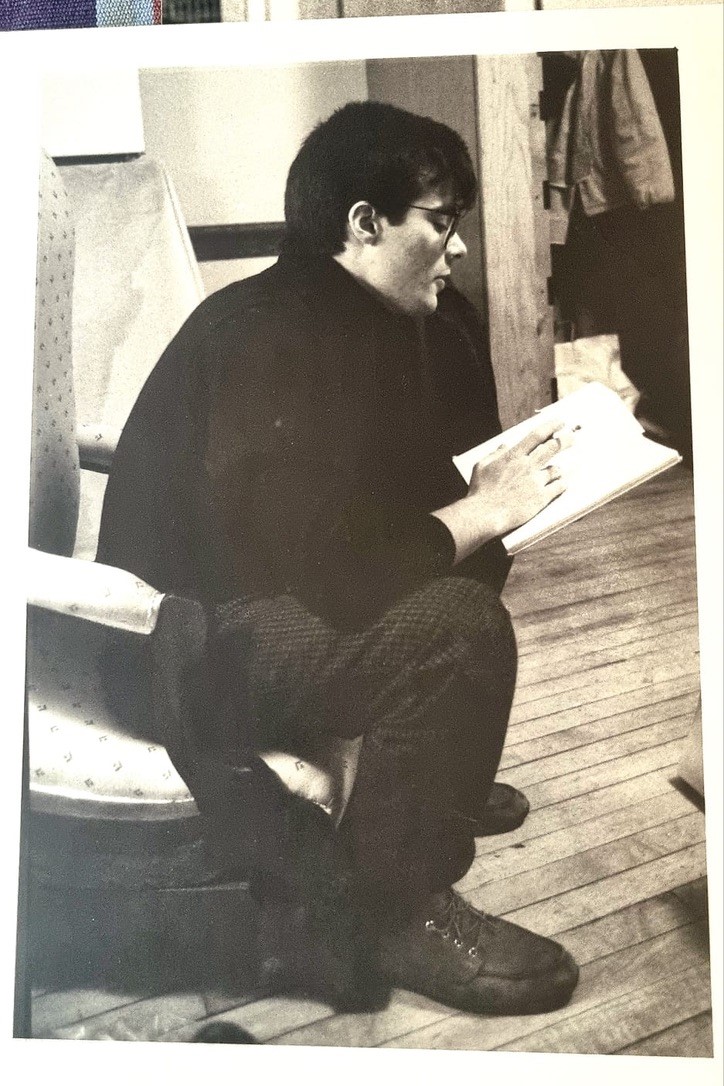
Could you give a summary of your background in publishing and as a writer?
Absolutely. So yeah. So out of undergrad, I went to my MFA at Warner Wilson College, which was in North Carolina. [I went to] Duke for PhD stuff, and across the state was Asheville, North Carolina, where I did my MFA. So I did my PhD and my MFA at the same time, but at 2 different schools.
I don’t know if it’s cool or not, but Warren Wilson was a program at that point, and still is, where it’s sort of, you go there for 2 and a half week periods, and then you go away and correspond with your mentor. So I worked with, say, like, Larry Levis, Heather McHugh, and some others. And it was a really lovely, an amazing, 2 years of… over 5 semesters.
So I was doing that while doing my PhD. And that was where I started, but I didn’t start publishing when I was in my MFA or in my PhD until later. I only started publishing, like, 1995 or something. And then in terms of publishing, I started with small journals, mostly gay journals, and just here and there, little spotty things. But it was at a time when – actually I think I’ve talked with you about this in class before – but watching in the nineties, most publishing and magazine stuff wasn’t yet paid. You didn’t have to pay for it. Whereas, the contests started to take over in the late nineties. In the US, you paid 15 to $25. Now it’s, like, $25 here, but you paid a bunch of money to, like, send in either a poem or a book of poems or a manuscript of poems to, to a contest. And that, unfortunately, was how I started looking at publishing, and I hated it. Contests are horrible because it’s not just that you pay money, it’s actually that you don’t give a shit once they publish whatever’s being published because you’re just like, you didn’t pick mine. Why didn’t you pick mine? Oh, look.
I’m comparing mine to this, and then it’s just a horrible feeling. It’s not like I’m discovering a new voice. It’s actually like, oh, this is better than you know, like, it’s not terrible little setup. So contests, it seemed to me, were just coming into their own. Now most journals, most publishers, and so forth, count on contests as a revenue stream.
Anyway, so that’s where I started in sort of the nineties – little journals and, you know, stuff like… It’s things that probably people have never heard of: Beloit Poetry Review, James White Review, Cream City Review, Plum. Maybe it’s called the Palm Review. I don’t remember. But, like, some of them are not around anymore, but some, like, the Beloit Poetry Review are still around.
And you worked, on the board of, I think, the Massachusetts Review?
Yes. So that was later. So I, got my first job teaching in Miami in 1999. So I went to Miami, and I was working there for a while. And then I got another job two years later at Wesleyan University up in Connecticut, and I was there for a while. And while I was there, I was living in the Pioneer Valley, Northampton, Massachusetts, if you know sort of around where that is. But in that area is Amherst, Massachusetts. So the area is, like, Northampton, Amherst, and Greenfield. Imagine this in Pioneer Valley.
But, so I got recruited. I had a piece on Jack Spicer’s detective novel that I had published with the Massachusetts Review, and then, David Lanson, who was the editor then, who has become a friend, or had become a friend, sort of recruited me to be an Associate Editor there. And so the first five years I started as Associate Editor, and I moved into being Editor at Large because I was up here. But when I was in Massachusetts, I was working at Master’s degree. And largely that was to do with both special issues, but also, like, sort of the regular poetry. And prose slash fonts and so forth.
When you were working there, what qualities did you look for in pieces that ended up being published, or were there specific types of pieces? I’m guessing you edited mainly poetry.
No. Actually, I did essays, poetry, and prose stories. It’s when you have an organization like that [that you would have] a poetry editor. We had a prose editor. We had the main editor, and then we had a story editor. So essays, stories, poems. Those people would be in charge of, in general, the stuff that came in, and then they would kind of, like, curate what they wanted for the… So we had two, Ellen Dory Watson and Deb Gorlin were our our poetry editors for a long time.
Again, each sort of domain got all of the stories, all of the poems, or all of the essays. But there were so many, and oftentimes, like, so many people sent us stuff that at the end of each period, we would have a slush – a pile of stuff, and we would all go through it. And in that, that was one of my favorite things. Like, we would all be sitting in this office, which was really disgusting, and basically it looked like this office, But, and just go through, read this stuff really fast. And then if anything sparked, we would so there were 2 different so when when you’re an editor, usually, what you’re looking for is something that gives you either feels like it fits in with what your project is or what you think you’re doing in the next issue or the next issues or a special issue. But when you’re in a flush fund, it’s just like something that, like, surprises you or pleases you or whatever. So that’s for me, my big thing is that I don’t really give much of a shit about people’s names, like people who I recognize or not. I much prefer to have something come off the page. And so that’s also a different approach. Some editors are very much like about, like, I want this I want name recognition in the people that I’m you know, like like the New Yorker. Like, New Yorker is almost all about name recognition at this point. Master’s review, you could publish there as a first time or a second time, you know, poet or fiction writer or SCS, and we didn’t really we we were sort of looking for exciting exciting stuff, and we also various. It’s a quarterly which started as a political a very political journal. So, so we had a lot of leeway, in other words. But, anyway, so that’s I I don’t know if that answers your question.
Based on that, how important would you say it is for people who are submitting to have, some sort of background on where they’re submitting? Like, should they read?
Yeah. Absolutely. You should.
You have to read where you’re gonna submit. You have to. There’s no point in submitting unless you’ve read. Like and, frankly, I I mean, I I now tell students, and you’ll probably remember this, it said I don’t send anywhere that I do not regularly read. So that means that I don’t send very many places because I don’t have very many places that I can actually keep up with all the time. And now there’s online. There’s inprint. There’s, you know, like, there are bunch of varieties. And I really suggest that you stick with what you go with what you know as, Amy Sedaris would say. But, like, just stick with where you live. Like, publish where you want where you wanna read. You because in some ways anyway, but that’s that’s what I would, I think I think it’s it’s go where you feel like you want to be read.
Well, now that you say, like, online versus in print, do you think there’s any difference or significance in publishing online versus in print?
Absolutely. So first of all, print is stable.
It sits there. Online doesn’t sit there. It moves around no matter what. Like, the mouse moves, you know, unless it’s a really, really stable PDF, even then the screen moves. So, it’s not publishing online is is a really great thing for distribution. It’s not a really great thing for memorability, for for for making a splash, I don’t think. I think it’s a really nice, wonderful, quick, very, very, like, you know, and you can do a lot with online journals. It’s just that some journals just don’t do that. They just are a clearing house of poem, poems, story, story, story, and they don’t do much with the design and so forth. If a website or a journal does along with design, I feel like that’s a really good you wanna be part of that. Like, I I think of, like at least I’ve enjoyed or liked the ex Puritan when it was the Puritan, and now it’s ex Puritan. It’s okay. It’s but it’s, again, like, it’s a nicely designed format, and that means that, like, you get to put some stuff out there. So especially with poets, I wouldn’t recommend if something looks sloppy on a website, don’t send. Also, who’s gonna sit and read? Like, look at how it looks because it really depends, you know, that makes a difference in terms of whether people are gonna read and like it. Yeah.
What advice, general advice, would you give to emerging writers or people trying to publish for the first time?
Well, first of all, emerging writers, I would suggest that, like, I wouldn’t think about publication as the only result of being a writer or the only way of being a writer. For instance, like, I published in journals my entire career, but I only published a book of poems when I was my late forties, 48. So I don’t like I not that that’s the only way to do it, but that’s one way to do it. In part, like, the question is why you want to publish and who you want to see what you what you’re publishing or what you’re writing. But that doesn’t mean, like, like, again, I think we oftentimes mistake publishing with the proper results of a writing career, and I don’t think that is. I think, like, if you have 2 people or 3 people who give a shit what you’re writing about, you win. So if you can expand that circle, that’s great, but those 2 or 3 people who give a shit are the that’s the goal. So and that’s often not in, like I mean, it might be later in your career in publishing, but it’s generally not early in your career in publishing. So, like, that’s the thing. Like, nurture those that are nearby, because those are the people you actually care about, and you know their judgment is good, or, you know, their judgment is their judgment. So, that’s my biggest advice for a writer is just don’t mistake publication as the proper result of a writing career. It’s not. And it’s not even that fucking fun. So, like, publishing can be fine, and it is a way of entering the public. It’s not always a great way of entering the public, and oftentimes people don’t care. Especially as a poet, I have to say, like, you know I mean, like so I was teaching a course on Canadian short story the Canadian short story, and I was worried, like, okay. So I’m gonna have to teach Alice Munro. Right? And there’s all sorts of things that are going on with Alice Munro. So I asked my class, like, so have you guys heard what what’s going on with Alice Munro? And they’re like, no. No. And then I was like, have you heard of Alice Munro? No. Really? And this is a Canadian class on Canadian. I mean, it’s like it’s very sweet, but, like, it’s again, we’re in a new period when, like, for instance, teaching a class on the Canadian short story is introducing people to the Canadian short story, literally introducing them to us. It’s not like, well, let’s fine tune, like, you know, what you know about the Canadian short it’s it’s we’re in a different world now in which, like, even a Nobel Prize the one Nobel Prize winner in the short story from Canada, the only one from Canada, and a class of Canadians in a Canadian literature course didn’t I’ve never heard of her. So, again, like, I mean, it’s a brave new world is is what I’m I mean, and it it’s so it’s exciting in some ways because people can re you know, can come across things for the first time that are fantastic, like Alice Munro, but and they may not have some of the the kind of baggage of recent stories, which is really complicated and difficult to deal with, like Alice Munro. And so, like, there’s like a there there are good things about it. But they’re also, like, we’re at a point where canonization or decanization is so complete that, like, there’s no canon anymore. There’s no like, we you can’t you don’t again, this makes a difference in terms of publishing, in terms of what is success. If success is winning the Nobel Prize, which happens to one person in literature once a year from the world, if that doesn’t matter anymore, what does? So, like, that’s the thing I think young writers really have to think about. Like, what do they wanna do? What splash do they wanna make? Where do they wanna make it? And why there? And then again, it kinda brings me back to, like, if you have people who actually adore reading your stuff or listening to your stuff when you read it, like, nurture that first. And then this other thing is another shell, another layer to take care of later on.
When have you felt most successful as a writer?
I like reading. I like readings. Readings feel really good, and that’s the other thing about readings is that it brings sort of, like, a bigger it brings your circle, your local circle often around you. Mhmm. And that’s very nice. And that’s to me, like, what as a poet, I it seems to me there are very few ways to succeed. That’s one of them. So readings and readings, I think, are the thing that everybody should be doing all the time, especially poets because that’s you know? With stories, it’s a little bit more complicated because sometimes you don’t have stories that fit in a reading. But yeah. That’s that’s success for me was well, I’ve always I’m I’m really glad to have I the books that I’ve published, I’ve really enjoyed publishing, and that’s been great, but they just disappear kinda. They just go poof, go into the world and disappear. I mean, they’re nice objects, but, but so really reading sort of that are are my feeling of I mean, I also I really like teaching because it’s sort of between when you’re waiting for write writing is a waiting thing, and teaching is a way of helping other people wait for what they’re what they’re waiting for, or helping other people identify what they what they might look forward to doing or how they might do it or whatever. But, anyway, yeah, that’s readings are where I felt happiest as a writer.
Given that the big five journals in Canada are predominantly in Toronto, what advice would you have for writers in other cities or other areas of the country that aspire to work either in publishing or in writing?
I don’t know.
I mean, I think, the first thing is sends to places you read, period. If all you read is the New Yorker and Harper’s, then don’t necessarily send to just places you read because that’s pointless. But start reading things and investing in like, if you love the Malahat review, get it. Read it. Send to it or, like, arc or whatever. I mean, it that’s just pick some things that you follow and get to know and then decide like, again, some poems are good journal poems. Some poems are good group journal poems. That I’m speaking as poet, but and some poems just are never gonna be in any prints or online journal anywhere, and you can figure that out at some point. You’re just like, well, that’s gonna be going the book. That’s not gonna go to the journals. But also, you might wanna think, like, maybe don’t send to journals. Maybe don’t give a shit about it. But, like, I don’t read very many journals as I’m saying. Like, and I at this point in my life, I used to read a shit ton of them, but, like, I don’t read that many, and I don’t care that much. It just doesn’t matter to me. Like, I love going to readings. I love hearing, like, getting glimpses of things, asking people what they’re reading, ask, but I rarely get it from journals. Sometimes journals are where they’re delivered. Like, that’s what I like is journals as delivery systems as opposed to as introduction systems. So if I have somebody who I’m interested in, I’ll look, see where they’re around. I’ll look up the journal, and then I’ll see other stuff in that journal, and maybe that’s really fascinating. Like, again, it’s not I don’t go to a journal in order to I go to journals in order to find stuff that I might already recognize, and I think that I’m a little jaded that way at this point. So I think, like, people need to if they’re excited about journals and excited about publishing in journals, go for it. The big thing I would suggest for young starting out people who wanna publish is publish your friends, period. Figure out ways to do that. Do it online. Do it do it in small venues where it’s gonna be for people who want to read stuff by you and your friends. And then you can expand your circle. And that’s what a great journal is. It’s it started as a little thing, and it ends up being, you know, possibly a giant thing. But, again, I don’t know. Like, so journals aren’t really my, at the moment, my object of concern. Though I think that they’re really if you find something that’s compelling, go for it. Like, I think that’s the like, but go for it in a way that’s not journals aren’t all journals. You have to find something I mean, journals are all journals, but journals aren’t all interesting. You have to find something that interests you, and something that’s interesting to somebody else might not be at all. And also editorial styles and moments. But even, like, say, the Puritan and the ex Puritan, it’s gone through a number of different structures of its editorial staff, and those have real effects on what gets published there, sometimes for good, sometimes for bad, whatever. It can improve, it can unimprove, but anyway, that’s I think journals are really a a puzzle now, and I think that the problem is that we imagine them as named things out in the world that we approach with our stuff. And you just go there, and if they like it, oh my god. The gatekeeper has let me in. That’s not what a journal is. Like, a journal shouldn’t be that. Like, if you’re reading a journal for that, it’s dead already. So a journal should be exciting, and therefore, it has to be recognizable but also surprising. So that’s what I my big thing about journals is that I’m no longer surprised. And I think with Canadian journals, I don’t know how to be surprised by them right now. I’ve more and more I mean, I I I love the idea of being surprised, but, like, I feel like when I look at well, I’m not gonna name journals, but, like, when I look at things, I feel like some things have gotten frozen in place in some ways that I just don’t like, that’s fine. It’s a fine journal, but it’s not for me. It’s not what I it’s not where I’m gonna get my sparks or what what’s not gonna spark stuff for me.
Having taught creative writing workshops, specifically poetry, what are some common mistakes you see students making, or would you consider them mistakes at all?
Well, the biggest thing about writing classes is that students don’t know how to let themselves be themselves frequently. And so that’s they’re getting in their own way. And I think that’s the biggest I mean, that was as a student, that was my biggest thing. I was a big editor of my own shit, and it was terrible. Like, it was really, really terrifically strict, like, down to, like, making things almost disappear on the page. So it’s just, like, a couple words here, a couple words there. And that was, like, I had to unlearn that. So for me, I find, like, I think maybe I project my own sort of learning curve onto other students, onto students that I’m in workshops with. But I think that, like, getting out of your own way is the number one thing. But then I also think reading. Like, I I come across students who don’t read like, in poetry workshops, I come across students who don’t read much poetry, and I I don’t understand how that works. I don’t know how you like, I don’t know where you get your vibe from if it’s not from other poetry. Like, that’s when I’m gonna write, I go to poems, and I think I don’t see how again, that kind of so getting out of your own way and then also going to the the medium itself as a muse. And I I guess also just the, like, the strictness sometimes that students find, like, they they that their editorial eye look when you look at another another person’s writing, I think sometimes you get a high off of being a good critic on somebody else’s work and then you fuck yourself because you can’t do that to your own work. You can’t produce work and be that little critical voice at the same time. It’s one of those things about workshops that I think is complicated because you want people to get really good as critics. You want them to be helpful and featurely in a way, but you don’t want them to do that to themselves. I mean, you want them to do have an internal internalize some stuff about their ear, but you don’t want them to be I told you what to do, and you’re gonna do it. Like, it’s just that’s awful for a proponent in particular. It’s really terrible. You need to be, like, doing stuff and figure it out later. So that’s it. I guess, like, those are the things that I would suggest are the biggest thing. Just getting out of your own way in various in various ways.
Well, based on that, like, my own experience in writing workshops and in sending my work out for publication, that there tends to be sort of an unspoken belief that certain types of work are better than others, like, in terms of genre, in terms of style. What do you think about that as a professor?
I am a good reader of some things and a bad reader of other things. So for instance, I am a really good reader, I feel, maybe I’m not, but of lyric poetry. Like, there are certain kinds of experimental poetry where it breaks apart language and just ends up, like, maybe I don’t even know how to describe it. Conceptual poetry. I’m not a good reader of it. I’m just not. And that doesn’t mean bad. It could be really good. It’s just not something that I’m a good reader of. So I think that that’s the trick is to figure out what you’re good at reading, not figuring out what’s good or bad. Because the good or bad is, like, I for instance, fantasy literature, I’m I used to read when I was a kid. I am no longer a good reader of it. I mean, I I used to love it, but it’s not something that I have a taste for and a a sense of and a sense of the different flavors of the delicate flavors of it. But I understand that it’s completely interesting. It’s just not my interest. Horror, for instance, is another thing that’s just not I I cannot read. So but that’s not but not to say it’s not a worthwhile genre or genre fiction. So with poetry, that gets people get even more kind of finely tuned, and they’re like, this is my kind of poem, and this is, like, this is the way poems should work. And my hope is that as a teacher, I’m not kind of, like, pigeonholing students in that way. I think the best thing about workshops is, like, all the various amazing talents that people bring, and then various ways in which they’re good readers of certain things, which may not be what I’m really a good reader of. So I think there’s a I don’t know. That’s that’s sort of what I the way I think of that, just in terms of being a good reader or, or identifying what you’re a good reader of and not dismissing what you’re not a good reader of as not doing. Right? And that’s, I that’s the big trick, I think. The big trick to all of this is that you learn to be humble, but also to be really arrogant in your humility.
Was there any insight in the writing world that you gained by being a part of the master of the journals that you wouldn’t have previously, like, been aware of if you were just submitting?
Yeah. So, first of all, that each journal is a machine, and so it has different parts, and they do different things. And so when you’re submitting, if you don’t know that and also you realize that, like, there is a giant volume. Is it like people send a lot of material? And sometimes it’s just gonna go right back. It’s because it’s not possible. The volume is so great or it can be so great. That’s one thing. Like and to not take that oh, the big the big piece of advice I have for students sending stuff out is you have to have a a deal with yourself. If you’re in it, you have to make the following sort of, like, absolute law to doing it. If it comes back, it gets sent out immediately. If it was worth sending out in the 1st place and it gets sent back to you, it gets rejected. If you don’t send it out again, you never should have sent it out in the 1st place. So you’re gonna have to send out shit a 100 times or maybe not a 100 times, but a lot. And I like, I don’t like, the rejections are so frequent and so complete and so common that that’s what you’re gonna get used to, not getting them accept not getting pieces accepted. So, like, when a piece gets accepted, you should be have to do a little snoopy happy dance, and then, you know, basically send out the other things that got sent back. So I know nobody who like, the people I know who are most invested in publishing in journals actually are really regular, like, about getting rejected and immediately sending stuff back out. That’s the one. The other thing that I that I would advise is not to spend money doing. Like, you can spend money maybe, like, some a little bit, but journals and contests and stuff have gotten or not contests, but people have put contests onto journals, onto presses, and so forth, and it’s all a scam. It’s a giant scam. Don’t do it. So it’s not that all of the contests are scams. It’s just that the contest culture is a is a just serious problem. And it doesn’t make any sense. It’s a funding model that just does it’s never worked. It never will work, and it’s ugly. So that’s the other thing. Like, I would try to if you’re gonna do contests, pick them very, very carefully and also understand that, like, they’re trying to fund their journal. They’re not interested in giving an award. Like, the award is just ancillary. And, also, think about when I get the other person’s poem that wins this contest, am I going to read it with gusto? If not, why would you want your poem in people’s hands who don’t wanna read it? Like, there’s just no like, again, like, that’s one of those things that I think is important. So so so contests and just the way in which you send to journals, I think, like, always sending stuff back out. Those are the two big points that I would emphasize. So I do think when it comes to rejection, it gets a lot easier once you’ve been on the other side of it. Absolutely. Like, the past year, because I know there’s so many factors that come into play. Yeah. Because it could be I know for soliloquy specifically looking for pieces that fit well together in an anthology. Always, like, last year, I think there was one piece that we all really loved, but it just wouldn’t fit in. Yeah. Like, that’s the thing. But, like, once you’re on the inside, you realize that, like, you can love stuff, and it’s just never gonna fit. Like, you can love it, love it, love it, and it’s just not gonna fit in that journal. We’re not gonna fit in that that issue. We’re not gonna fit in that kind of whatever, in that particular model of what the journal’s doing right then. So so, you know, I mean, you can like, that’s the amazing thing about editing is that you I mean, when I was editing I was editing a master view for this, UMass Amherst MFA program, the 50th year anniversary of theirs. And, like so I had these amazing writers, amazing writers, send me stuff like Eileen Miles. And, like, I was, like, well, I can take this one, but not this one. And it’s, like, from people that you absolutely admire in and it’s poems that are really good, but you can’t take them all because, like, the idea is yeah. But, anyway, like, dealing with somebody like that with poems that are so strong and yet realizing that they’re not gonna she sent me a bunch of them, and I could only pick 1. So, like, it’s not that I didn’t like the other ones. It’s just that the one worked really well, and I really liked it too. So, like, what you’re saying is, like, I I don’t think as an editor, you have to learn, I think, to be able to say, I love this. We can’t take it. This is really good. Make sure to send this out instantly. But, anyway yeah. I mean, it’s it’s like, the reason why I think young writers think that or I always thought, I maybe still do, that when you send out a poem, it’s like, oh, I need the approval. I want the approval. And you do. You want it, and you do need it, but it may not be what journal editors are willing to give you. How important do you think it is to be open to edits? And, like, how, like, detached do you have to be from the piece? Because usually when you’re submitting, you’re submitting a piece that you really like and that you think is good already. Yeah. I don’t I thought I there’s no answer. I don’t think there’s any single answer to that at all. But, like, sometimes, like, I had a a poem in a, League of Canadian Poets, little chat book. And it was it was just like and it was Natalie Blythe who was who was editing it. And he basically chopped off the last line of a poem where the last line was the poem, basically. But it was really good. Like, it was real like, it was actually better. And so it was, like, having that having it come back having a poem come back to you and having the thing you loved about it, the little, like, you know, curly tail at the end of your pet pig cut off was just, like, oh my god. Like, how did why did you do that? And then realizing, oh, my pet pig is cuter in with a straight little straightened tail or whatever. But that that’s like a that’s a serious that’s a just a there’s no figuring that out in advance, though. Because, you know, editors can do shitty things and do. But editors can also do shitty things that end up being magnificent. Like, even if they originally seem like they’re kind of violent to the to the work. So, anyway, that’s yeah. That’s complicated. I I, as an editor, almost never do much except for short. Like, I don’t like to change stuff by writers. I that that seems to me the job of accepting or rejecting. Like, I accept it. It’s ready to go. And if I have to do a lot with it to get it into a journal, I’m not gonna take it because I don’t wanna do what you’re saying. I don’t wanna wreck something, or I don’t wanna change it out of out of a recognizable form. But yeah. So that’s a really hard issue. But, also, student I mean, the great thing about student stuff is that, like, there’s all this excitement. Like, that’s the thing that, like, when we talk about journals, sometimes the overwhelming amount of stuff that comes in overwhelms the excitement of you get to see all this stuff. People are giving you this this chance to read what they thought was a really an amazing thing, and you get to you get to either discover it or move on to the next thing and possibly just and that’s really awesome. I mean, that’s an awesome thing to do. That’s one reason why I think journals are I think journals are a place that you learn how to be excited by other people’s writing. If you’re not, say, if you don’t want to teach, if you don’t want like, there are different ways of doing this, like, being in a community, a writing group, or, you know, being in a journal, or teach, or, you know, there are a bunch of different modes whereby you get the you get the excitement of, like, oh my god. Other people are amazing. And that’s what writing’s about. So, like, if you can do that with a journal, that’s awesome. But I think I I often see people burn out of journals after a couple years just because it’s hard work to tell people no. Like, that’s just not a very pleasant like, no. We don’t want your peace. No. We don’t want your peace. And then every, like, hundredth time, you get to say, yes. We really want your peace. That’s just bizarre. So, so people burn out real fast. Thank you for talking. Sure. I hope that’s not that wasn’t too blabbering.
 Soliloquies Anthology 30.1
Leave a comment