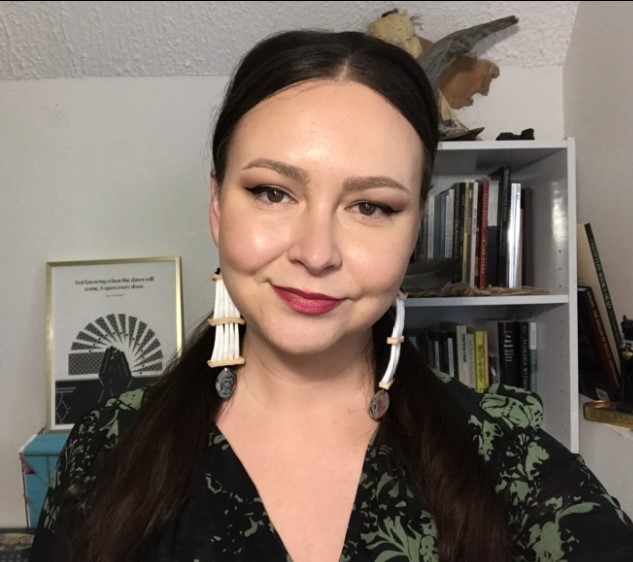
From Poetry in Voice: “Liz Howard was born and raised in northern Ontario. She received an Honours Bachelor of Science with High Distinction from the University of Toronto and an MFA in Creative Writing through the University of Guelph. Her first book, Infinite Citizen of the Shaking Tent, won the Griffin Poetry Prize in 2016.”
Can you give a general summary of your background as a writer and how you kind found yourself writing?
Well, I suppose my poetry journey, in a sense, started really young for me. When I was six years old, I was going through some old boxes in the basement of where we were living&, and I found a bunch of books. There weren’t a lot of books in my house growing up, so I was surprised to find them. And I think what had happened was my mother was in high school, and she ended up dropping out when she was 16. And I think she neglected to return some texts. And I found a copy of Shakespeare’s Macbeth in there and I started reading it. And of course, I didn’t understand everything that I was reading, but there was something about the language that just kind of really settled and, you know, launched itself sort of like within my mind. And I found my thoughts moving to the rhythms of the speech that I had read in the text.
And so from there I started keeping journals and writing my own poems. And at first, they were pretty, you know, standard little kid poems for somebody who grew up in Northern Ontario about nature, foxes and rabbits in the wintertime and bears and things of that nature.
And then as I got older, I graduated to not only reading Shakespeare but going through the poetry section at the town library. And I found, you know, collections of modern verse, and I found I really liked Dylan Thomas, and there’s a lot of Canadian poetry there. So I started reading Leonard Cohen and Irving Layton, Susan Musgrave, and I found my writing starting to sort of evolve into more sort of imaginative and emotional realms. And I wrote a lot of, I guess, sort of moody goth poetry as a teenager, very much inspired by Sylvia Plath and Anne Sexton.
But, you know, growing up in a small working-class community, I never really thought that I could go away to school to study writing or even something like English. And so, after high school, I ended up going to university for psychology and studying specifically psychology as a life science. So, I was interested in neuroscience. I was interested in cognition and biological basis of behavior. And that really occupied all of my time for a while. But I graduated from university and I found that working, I was able to have sort of more free time to explore things of interest for me. And I started taking poetry workshops and going to poetry readings. And this is when my, I guess, writing career really began in earnest. And I started writing poetry and performing it on open mics and submitting it to small journals.
Eventually I decided that what I really wanted to do was write a book. And I felt in order to do that, I would benefit from the structure of writing program. So, I applied to the MFA program through Guelph University, and they have a campus in North Toronto, so that’s where I was living at the time, so I wouldn’t have to move, and I got in, and I got to work with a bunch of incredible writers like Dionne Brand, and Margaret Christakos, and Lisa Robertson. And by the end of that program, I left with a manuscript which ended up being picked up by McClelland and Stewart, and then my first book came out, and it was miraculously very successful and changed my life and sort of set me up on a trajectory to be here speaking with you today.
So what was your experience like when you first were starting out trying to get published? Do you have any sort of tips on that regard?
I found it very difficult. It was very discouraging. For the longest time, I sort of felt as if I couldn’t pay a place to publish my poetry. The sort of poetry that I was writing
would be considered experimental. I was really influenced by language poetry, which is about sort of really using language as a material versus just a vehicle for sort of expression. So, my poems weren’t sort of like very overly, sort of like, emotional or imagistic. So, I had a hard time placing them.
However, I did learn about this one journal, the Capilano Review, which was and is published out of Vancouver. And I noticed that many of the poets that that I had, that I admired and read, you know, in the backs of their books, it’s listed [that] the poems were previously published in X, Y or Z place and many of them had published in the Capilano Review. So, I sent them a few of my poems when they had an open call and I was accepted. And that journal has been a great supporter of my work for many years, so I was grateful for that.
So, in terms of tips for submitting to journals, it’s very important, of course, to do your research. Take a look at the journal, their submission guidelines, their submission dates, and also, you know, try to read a few issues if you can and see if your work, in fact, would be a good fit is, you know, has some sort of similarities or family resemblance to the type of work that they that they already publish. And of course, even before you reach the stage of submission, to really spend a lot of time with your work and make sure that you’re sending out your best polished pieces. Make sure to try and perform your work or share it with other writers and have their feedback. It’s really helpful.
So, on the other side of that, I saw you regularly judged poetry competitions. And so, what’s it like being on the other end of that process? Did you gain any sort of insights in the judging area?
Yeah, I would say something that was really eye-opening for me was [that] I was, years ago, a first-round judge for the CBC Poetry Prize. And of course, there’s, you know, I don’t know what it is now, but back then I think it was like a $25 entry fee. And my job is to read through almost 400, 400 submissions, which I thought was incredibly daunting. But what I found was a good percentage of the poems, of the work that was being submitted, I felt like had just kind of been dashed off. A lot of the pieces just sort of like read almost like a journal entry or a piece of prose.
So, I think it’s really important to have a sensibility around poetry and to make sure that you’re submitting something that is going to catch somebody’s eye in in a sea of submissions like this.
And in general, as a judge, what I’m looking for are works that are taking risk, risk in some way at the level, it could be at the level of form; it could be at the level of voice… I want to feel sort of moved or stimulated or even slightly sort of disturbed or intellectually engaged or emotionally engaged with a piece. That’s generally what I look for.
So how would you describe your writing process and how it’s developed over the years as you’ve gotten better?
I think part of my writing practice has always been like a lot of quote unquote, like free writing or automatic writing where I have a notebook [and] I sit down at my desk or outside if possible. And I just sit down and I just write. I just write these pages and pages of dense, just prose blocks. Sometimes naturally, you know, line breaks will happen. And this is just in order to just generate content.
The most important thing for me is to just, it’s just putting pen to paper and trying to produce as much as possible. So anything that’s coming to mind could be observations from the day, something that I’m reading, a dream that I had, a conversation I had. I might be listening to a piece of music and that might influence the rhythm of what I’m writing. And if I’m able to get into what I feel is a really conducive state, usually by, yeah, spending a lot of time with writing or reading work that really stimulates and moves me, I kind of am [able] to sort of listen and tap into something. And I can almost receive or hear lines and words and bits of musical phrases, and I write those down as well.
And then when I have all of that material, I go back and almost sort of like circle or underline or cherry pick things that I find really, really interesting. Here’s a really interesting phrase that I wrote or an image or how something was worded is interesting to me. And then I pull all of that material and sort of shape it and rearrange it and write into the gaps between things to make connections. And how has that sort of improved over time? It’s almost counterintuitive, but I’ve learned, I think I’m learning to trust my voice more without the need to pitch up the language of things to to 11 all of the time.
So as a creative writing professor, specifically with poetry, what kind of common mistakes do you see students make?
Often the use of abstractions like being in pain or like talking about beauty or sorrow or, you know, things of this nature. When what you really need to do is make the reader feel that experience that in their body through images and metaphor and yeah, really painting a picture. And I always stress that it’s so important to try and root things in the body so that the reader really feels what the speaker is feeling. And experiences what the speaker is experiencing.
How do you deal with, when you were starting up, how did you deal with rejection?
I suppose it was discouraging at first, but I would just try and keep going, keep writing, commiserate with other poets who were experiencing rejection as well, but also sort of cheering for those who were having success as well. And trading sort of like tips and poems as well. And also at some point I kind of felt that my work was just too, was just sort of too radical to be published and I almost for a time, wore it as a badge of honor and I just sort of let my freak flag fly. And I was like, I’ll share…there are some places that appreciate my work.
And often when I read and share my work with others, like going to reading series and open mics and stuff, I’d get a lot of like positive feedback there. So I just reinvest in community and my own practice as a way to deal with rejection. It’s part of it. It’s part of any sort of like creative activity in which you’re setting yourself up to be evaluated.
What was it like, because I saw you did the Montreal Poetry Prize, what was the process like for you?
Just reading through all the submissions a number of times. So, I think I was given a, I don’t know how many poems, 75, 100 or something? And I had to select five. And again, I found the majority of the offerings didn’t seem to be polished. And so… you can move quickly through some of some of the submissions. But then when you’re sort of boiling it down to the last sort of dozen or, you know, ten of them, it gets a little bit more challenging. But again, I’m always looking for something that is taking a little bit of a risk, doing something a little, doing something a little different, making me see things in a different way, showing me something unexpected.
What gives you confidence as a writer?
What gives me confidence as a writer? When I feel like I’m tapping into something that’s resistant within me. And I feel as if I’m talking back against something that would prefer my silence.
I have another question, just because we’ve been talking about it in a few of my classes, like CanLit as an industry versus as a creative thing that’s celebrated. Having published work in that sphere, what are some things you love about CanLit and the publishing industry within Canada, and what are some things you think that could be better?
That’s a good question. I would say that it’s important to find your people within CanLit, the ones that inspire you, the ones that support you.
In terms of what could be better, I think efforts are being made to hire more diverse editors, like the publishing industry itself needs to be more diverse than it previously has in order to, in order that, you know, different, different voices have a chance to be published and express themselves as well.
 Soliloquies Anthology 30.1
Leave a comment