By Olivia Murphy Major
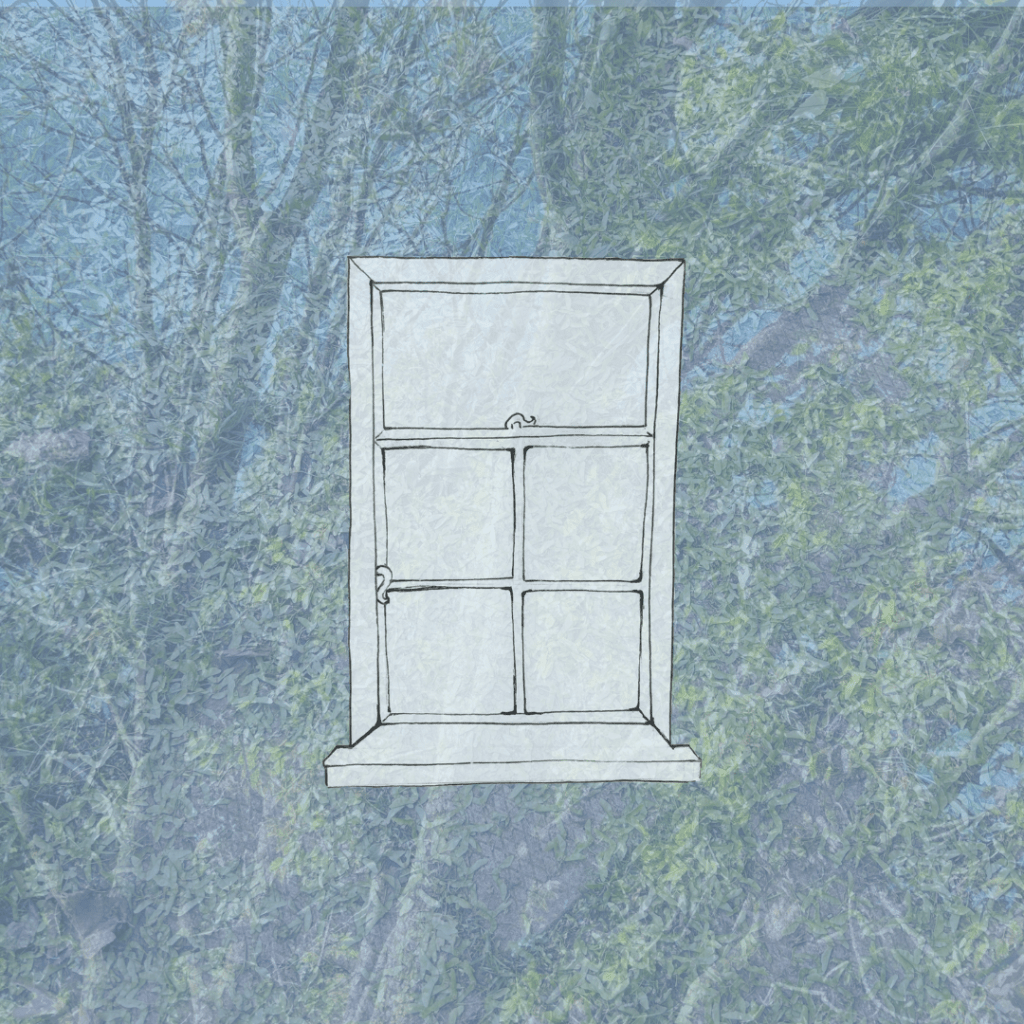
After James’ mother died, he stayed in her old house. At certain times during the day or night, he sat in a lounge chair by his bedroom window and watched the neighbours. It was late March; the ground was beginning to thaw, and the tree branches were decorated with tightly furled buds. It was warm enough to go outside, but early enough in spring that the leaves had not yet filled the trees. In mid-summer, when the line of trees between their houses was lush, James could not see the neighbours, only little diamonds of colour—the pale yellow panels of their house, flickers of the green washboard shutters. Now he could see straight through the brush and into their windows, their yard.
The Bensons were an old couple. James guessed they were in their seventies, but Ray Benson still worked as a plumber. His wife, Evelyn, hardly ever left the house. In the early evenings, Ray sat outside alone. James watched him—his old, sun-reddened skin, his baseball cap over his squinting eyes. He always sat in the same white plastic chair and threw the ball for the dog. James sometimes walked down the driveway, pretending to check the mailbox at the very end. He would look over at the Bensons and give them a nod, trying to acknowledge them, but they always pretended not to see him. They only turned their heads a little in the other direction and carried on doing whatever it was they were doing. James decided that maybe they thought it was polite.
James only left his room when he had to. Otherwise, he watched the neighbours or lay in bed thinking. He often thought of being a child. He went over what he could remember from childhood in his mind. Sometimes he tried to picture his mother’s face as it was years ago. He could not recall her face with absolute clarity, and it frightened him. He remembered the Christmas parties they used to have—the frothy eggnog, and the ribbon candies, their garish colours in a big crystal bowl. Falling half-asleep in his mother’s lap as the evening wound down, his ear on her chest, listening to the underwater sounds of her voice.
She was rarely ever cross with him. Except one day, James remembered, as a child, when he went down to the river. He had gone into the backyard, down a narrow path between the trees. His mother had warned him against going there alone. A little boy died there once, his mother had told him. It had been a day after rain, when the river was fast and pale with mud. Whoosh, James’ mother had said, sweeping her fingers past his eyes. He had to see it. He lowered himself down the bank, gripping the trees, his fingers stiff with cold. He lost his footing and slid down until a jagged piece of ice caught on his pant leg. It ripped through to his leg and made a long slice down his thigh. He found his way back home. His mother dressed the wound carefully, but she was quiet with anger. Every night for weeks afterward, James ran his thumbnail down the cut. He had wanted to have a scar so that he would remember. Now it was long and white, like a fishbone.
James thought and slept and had the same dreams each night. Dreams where he would venture out of his room and find things shrinking and moving, coming to life—the dining room table the size of a quarter, the hall mirror reduced to the size of a peephole in a door. They said urgent and unintelligible things to him. What’s happening? he would ask, and no one could answer.
Later that week, James emptied a can of soup into a pot and heated it over the stove. Once it was ready, he took it into his room and sat in his chair. He looked through the Bensons’ windows, which, in the bluish dusk, were perfect boxes of light. They had the TV going. He could make out the television screen and beyond the living room, into the kitchen. He could not see the Bensons but he knew they were there, sitting on the couch together. He was desperate to hear what they were saying to each other. He wondered if they spent a lot of their time in silence. He wondered about knowing someone for that long.
James spooned soup into his mouth, without stopping, the food warming his throat. Eventually the Bensons turned off the television. They put the remotes on the TV stand as they always did, arranging them in a neat little row, and then they went up to bed. When their light went out, James waited awhile in the chair and looked at the quiet house. He leaned over and set his elbows on his knees, holding his face in his hands. He rocked back and forth and brought his fingers up to his temples and pressed them there. Then he got up, walked into the kitchen and rinsed his bowl. He poured himself a glass of milk and drank it. He went to the bathroom, brushed his teeth and spat into the sink. In his bedroom, he turned the lights out and watched the trees outside his window swaying as the wind went through them. He fell asleep thinking about the trees, their roots deep in the ground, tangled and sprawling in the dark.
The phone rang at ten o’clock in the morning. James rushed over and picked it up.
“Hello?” he asked, holding the receiver slightly away from his ear. His voice was hoarse.
“Yes, hi. This is Ray, from next door. Do I have the right number?”
James was quiet.
“Hello?” Ray said.
“Hi, yes, I’m here. Yes, you have the right number.”
“Good. I found your number in the phone book. I’m calling ‘cause we’ve got a potluck happening tonight and my wife thought I should see if you wanted to join us.”
A silence fell between them. James looked down at his arms, his black shirtsleeves, and began picking lint off of them.
“Oh, that’s very kind of you,” he said, “Sure I’d like to come.”
“Alright. Like I said, starts at five o’clock.”
“Ok,” James said, “I’ll be there. What should I bring?”
“I dunno,” Ray said, and then, sounding farther away, “Honey, what should he bring?”
James heard a murmur on the other line, then a shuffling sound, then Ray’s voice again.
“She says something sweet. A dessert. But no trouble if you don’t bring anything. It’s short notice.”
“Ok, thanks a lot. I’ll see you later.”
“Yup.”
James went to the store and bought a frozen apple pie. He put it in the oven until it was cooked through, the edges browned. At a quarter after five, cars began to drive up and accumulate along the length of the Bensons’ driveway. James waited at his window until there were five cars, and then he got up from his chair, put on a button up shirt and slacks, and walked outside. He considered crossing over to their yard through the tree line that separated the houses, but thought better of it. He walked all the way down his own driveway and then all the way up theirs. When he arrived, there were two children taking turns chasing each other across the lawn as the dog ran between them, and several other children were jumping on a trampoline. There were people standing together beneath a blue tent. The aluminum bottom of the pie tin warmed his hand.
“Welcome, welcome,” Evelyn said, holding both of her arms out. “I’ll take this,” she said, grabbing the pie with one hand.
“Thank you,” James said. “Thanks so much for having me.”
“Of course,” she said, smiling at him. James noticed her yellowed teeth.
“Now Ray’s just inside,” she continued, “but he’ll be out in a minute and maybe you can help him with the grilling. We need to get these burgers going.” She snapped her fingers with her free hand.
“Sure, I’d be happy to,” James said.
“Let’s go set this down,” she said, gesturing with the pie.
She turned and James followed behind her. Her gray hair was done in a long braid down her back, swinging as she walked. She set the pie down on a white table beneath the tent, where bowls and containers of side dishes were wrapped with foil. Evelyn arranged them beside one another. He could smell something cooking and grew hungry. Under the tent, people gathered in a circle. There were couples with their arms around one another. They were laughing. A few of them looked over at James and he looked quickly away.
“There we go,” Evelyn said.
“Could I use your restroom?” James asked.
“Oh sure, just go up into the house, take a left when you get to the kitchen and it will be right there.”
James thanked her and walked into the house. He came into the entryway and looked around to make sure no one was there, and then he walked into the kitchen. It was not quite how he had imagined it. He saw the familiar wall with the television which he could see from his own window, and he saw the couch, which looked deep and velvety. He walked over to the sink and picked up the wet sponge that lay beside it, then set it back down. He looked under the sink where all the cleaning supplies were stored. He went over to the dining room table and ran his hand over the tablecloth, which was stitched with outlines of birds. He touched their wings, their crowns of feathers, and felt they were alive somehow. James turned away and went over to the fridge. He opened it and took account of what was there. Breakfast sausages, a bowl of fruit salad covered with cellophane, a bottle of mustard, a carton of eggs, a pitcher of iced tea. He heard someone coming and shut the refrigerator door in a hurry.
James went through the side door and out onto the deck. This side of the Bensons’ house was the only part he couldn’t see from his place. He smelled smoke. He looked over at a fire pit where short flames wavered and coals glowed orange. Something was hanging above the fire, and James tried to make sense of what it was. He walked down the stairs of the deck and onto the grass; he got closer and saw the head, the feet. It was a whole pig on a spit. Incisions had been made in long cross-hatches all over the pig’s body.
James heard the sound of the screen door opening and he turned around. Ray Benson walked out, holding two bottles of beer, one in each hand.
“Isn’t she something?” he asked James.
James stared back at him, his mouth slightly open.
“Saw you out here and figured I’d bring you something to drink,” Ray said, coming closer, walking down the wooden steps. James could hear him breathing heavily.
“Thank you, sir,” James said, taking the bottle from Ray’s hand.
Ray came to stand beside him. James brought the bottle to his lips and took a sip of the cold beer. James glanced at Ray, who was looking out at the pig. Ray’s eyes looked small and black; they gave off a cool, dark sheen, like metal. James breathed deeply. The air held an early-spring sharpness. He smelled pine needles and woodsmoke. The sun was low, coming through the woods, and it threw golden light all over the lawn, with stripes of shadow from the tree trunks.
“Here, you mind holding this for me?” Ray said, handing James his beer. “I gotta turn her over.”
James watched as Ray walked over to the pig. He took hold of the long, curved handle at one end of the pig and turned it carefully, slowly, until it was belly-up. James could not look away. The pig’s eyes were closed. Its face was blackened where heat had seared it, and the ears were thin and charred. James looked at the rod coming out of its mouth, and the front legs which were curled up to hide the sides of its face.
That night, James woke up while it was still dark. He felt as if he still might be dreaming. He walked through the house, down the narrow hallway, slipping through the dark, feeling the silken quality of the air on his shoulders. He traced his fingers along the wall so he could feel where he was going; he kept his hand low to avoid hitting any hanging pictures. He felt an undercurrent, a quiet electrical hum at the back of his brain. James went out into the front lawn and walked to the treeline at the border of the neighbour’s yard. Bats swooped low and circled the trees. James stared out at the Bensons’ house. The blinds on the windows had all been closed. He could see that the lights had been turned out, and he pictured them in their bed. He felt the spring-thawed ground beneath his bare feet, cool and soft, muddy in some places. One of the bats flew and circled around him; he heard the leathery sound of its wings. He stood for a long time at the edge of the treeline, feeling his chest rise and fall. James looked down and saw strawberry blossoms which had come up during the night. They covered the ground in small, white, roundish blooms, glowing in the near dark.
 Soliloquies Anthology 30.1
Leave a comment