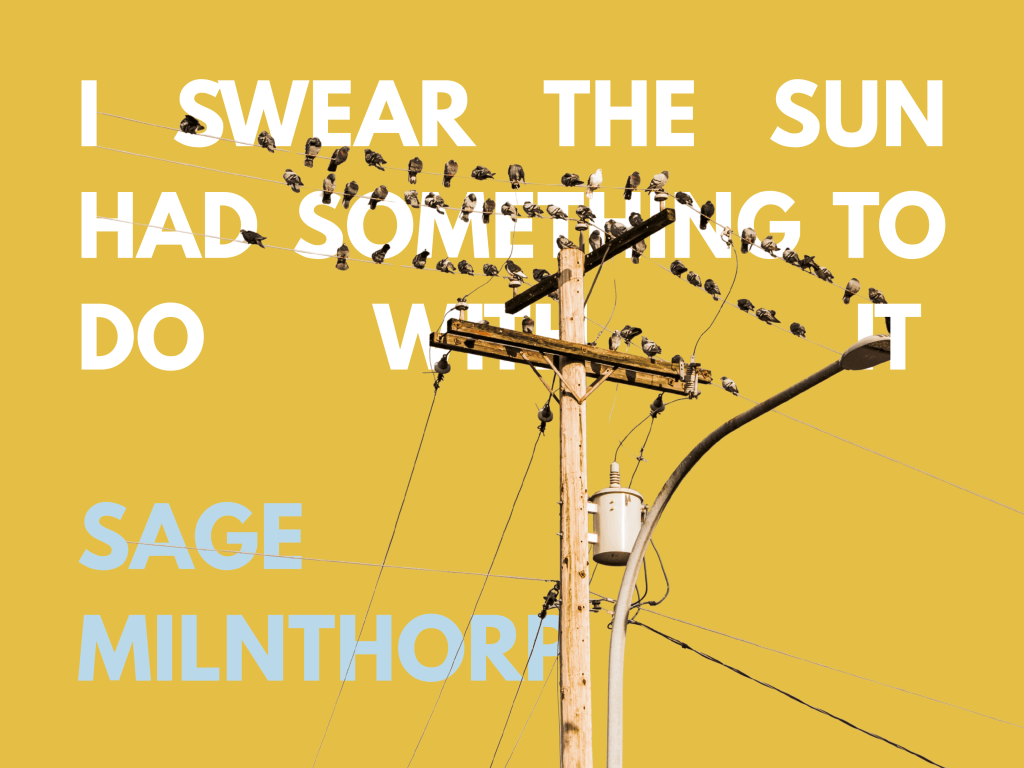
Lying at the foot of my bed, I can feel the cool evening air coming in from my window. The last remnants of daylight are dancing around on my bare bedroom walls. Projected by the light of a dying sun, this lifeless room is suddenly overcome with movement. As the night begins to crack open, I see that the sun can do more for a room than any framed art or decoration. I watch the walls become a plate for the sun to spread its gooey yellow yolk. Brown sideboards and arches like the crusts of whole wheat toast, gone soggy and saturated in the pooling wetness of the plate. My room is full and alight. My body is covered with a glowing wash of nostalgia. I lie there, basking in the warm feeling, listening to little indications of the living as they carried on outside my window. In the dusk somewhere, a plane flies overhead, someone rattles a stolen shopping cart down the street, and a car revs its tired engine.
We spent months of the summer with bare shoulders and open hearts. Carrying bouquets of freshly cut flowers, sitting on crowded patios, drinking iced cocktails that sweat cold droplets onto our mini skirts. I looked at my hands, at the whiteness of my palms, the places where the sun forgot to kiss me. The fading tan lines, like an old film camera you never get developed, memories slipping away with the faded ink. I spent months of the summer learning how to be a person again. Not a student, just a person. A person who laughs easily, who calls their mom when they have the time. A person who buys a wheel of brie and eats it with bread in the park. A person who falls asleep on the balcony, novel bent open on her chest. I swear the sunshine has something to do with it. Lying in the sunlight like this, I always feel forgiven. Like every bad thing I’ve ever done isn’t so bad. Like the world is smiling on me, and I am smiling back. Here, underneath the impossibly big stretch of blue sky, my body could just be a body, and I am alive and forgiven.
But summer isn’t forever. And this is home now. I have a freshly emptied suitcase lying underneath my bed. A closet full of sweaters untouched for months, still smelling of dust and cheap laundry detergent. Change can feel unnatural sometimes. Now, I carry my body through my daily commute; soon I will do these things naturally, without having to think.
On the bus home from downtown, I notice a girl sitting across from me. She’s wearing pants that flare like the edges of a shiny new paintbrush. Her dark hair barely brushes the top of her tattooed shoulders. Like an emblem of shining silver, she is perfectly bejewelled and polished. She looks like she belongs here. Resting her eyes, her neck cocked to one shoulder, and her body lulling left and right with every reluctant acceleration of the rusty city bus. I became aware suddenly of the dull movement all around me. People hunched over, their heads stuck in a phone or a book. Tired bodies, holding grocery bags, sagging backpacks and empty lunch boxes. A father holds his daughter’s small hand. I rest my head on the greasy bus window. I let my eyes wander, tracking the brick and mortar of my neighbourhood. Green vines all tangled in the fire escapes, glistening leaves gathered in the rain-soaked gutter. At this hour, the sidewalks are fairly empty, and yellow dining room lights begin to flicker on. People arriving home, calling into the hallways and bedrooms, kicking off their shoes in a pile at the door. When you are downtown, it’s easy to forget that we are all human. That we are all trying to get home to turn on the dining room light. The city can feel almost lifeless, rife with nondescript patterns of black and white. As if a painter, with crazed hair and erratic hands, had blindly taken to a white canvas. Marking it up with thick strokes of dark, oily paint. This place becomes a monochromatic blur. A senseless hustle and bustle of people with very important things to do. Pigeons and cigarette butts, white-soled shoes gone grimy at the edges, cleanly bleached dress shirts, ironed ebony pants, all turned to a dizzying whirl in my peripheral gaze. Here, the people are sharpened like sewing needles; they snake in and out of a metropolitan embroidery, weaving their own stitches in this delicate tangle of living thread. To my left, a man sat in a worn-out-looking suit, with the remnants of a mushed crab apple clinging to the bottom of his shiny black shoes. I wonder how our very important lives are interrupted by the rushing tide of the seasons. I wonder about what this particular season brings, as the bus slows to a halt, and the automated robotic voice calls out my stop.
Stepping off the bus, I noticed the sky was turning a deep orange. A marshmallow left too long in the lick of the flames. The last of the summer was dying, and with it, everything living began to wrinkle and brown on the trees. I take the walk home slowly, letting the bite of the evening turn my cheeks rosy. How can I find a way to hate this beautiful season? Maybe if I hate it hard enough, it will bring me back summer, even just for a day. Everything serves as a reminder. All around me, there was a memory of what had once been and what will continue to be. A fight between green and grey. Like in the manufactured park, with its well-lit paths and rusted steel fences. Which, from a bird’s-eye view, looks like a carefully drawn mandala pattern. Where its slivers of green and grey, bridges and ponds, are all interlacing with each other. Even here, the fight between green and grey continues until, eventually, for five long months, the grey will prevail. So, instead of choosing hatred, I choose to mourn. I mourn the sunburn that fades fast on my shoulders; I mourn the nights spent sleepless, sweating in cotton sheets, fan on full blast. I mourn the green, the orange, the quiet lull of the crickets, a sky with nothing in your way, nothing, not trees or mountains or buildings, only sky. And I mourn, while the trees shed their reddened leaves into the gutter, scattered and mangled like chewed apple cores. I mourn, while the squirrels scavenge, and the birds pack their bags.
I mourn until, eventually, like the squirrels, I gather my warm bedding. Like the rabbits, my coat begins to turn. I mourn until I remember that life is made to survive, through the cold, slate-grey winter, through a place that might not yet feel like home, until the melting snow reveals summer’s moulded leaves, until all we have are memories of the green.
The transition from summer to fall is an easy one for some of us. Montreal, in all its multiplicities, offers one of the most beautiful funerals for the dying summer season. Huge maples rot with elegance, bleeding rich crimson leaves that scatter like confetti in the wind. Little old men wear their eccentrically framed glasses and their colourfully patterned scarves. There is a smell of rain in the air, a smell of brief newness, a Kodachrome celebration of the summer had and gone, a last hurrah before the grey-slate winter months lay a thick sheet of frigidity on the city. Most days, nostalgia burns like a hot candle in the back of my throat, remembering the dog days of my summer, when plans and assignments were only whispers, and laughter was the most valuable currency in exchange. I know that summer ending and fall beginning is the natural order of things. Does that ever make it easier? I have trouble letting go of things, people I have been, people I have met, memories I have made. And summer is full of this. But perhaps life is a series of remembering and forgetting. Perhaps life permits change. In any case, like most of us, I still feel that I have only one foot in the door of this new semester. I’m sure with time, the feeling will fade. I only worry about what feeling I will be left with. But like the seasons, feelings will eventually defrost. We only have to get through the winter.


Leave a Reply