The first thing you’d think, looking at Windscale, was that it didn’t belong there.
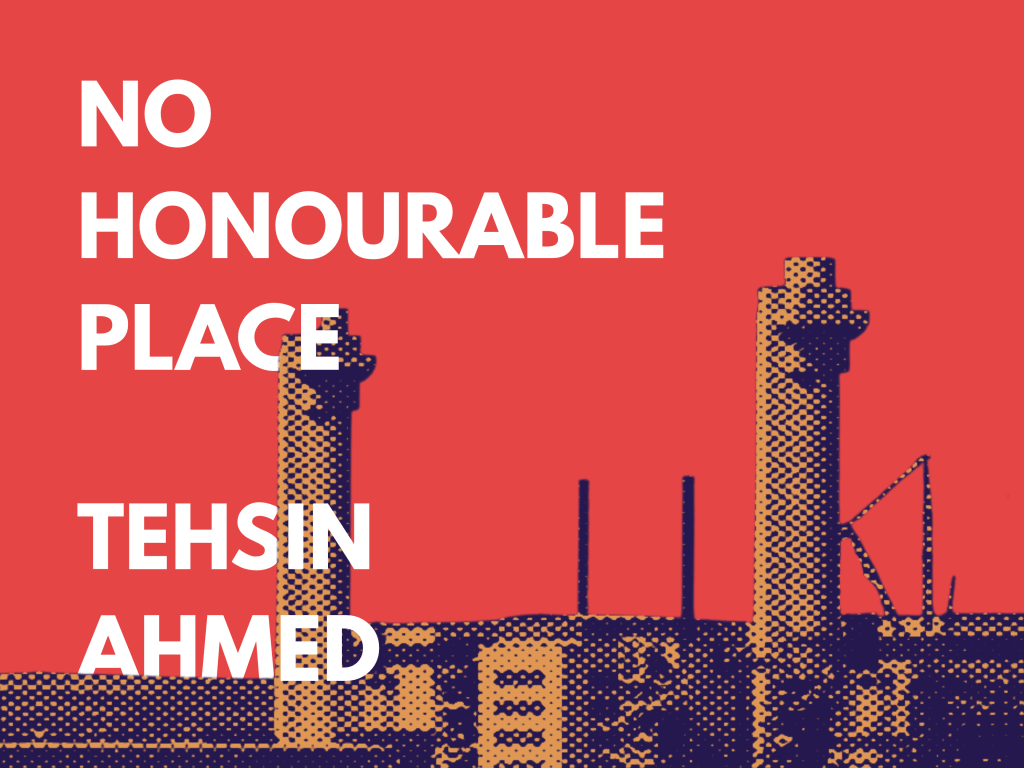
On the U.K.’s west coast, beneath a bruised and purple sky, the Cumbrian fields roll gently towards the sea. Electric pylons shamble across them like lazy giants. Maybe, when you think about it, you picture it through a camera lens, complete with the indistinct and fuzzy grain so characteristic of the fifties. Look out, across those fields, to where the buildings appear: the gridded complex and the steel, the open-gulleted chimneys, and the piles—they called the two reactors piles, but they looked like aircraft command towers. The piles were inside, in the uranium, threaded through the graphite.
There is something peculiar about how Windscale was built. Not unique to it, certainly, but nuclear plants all have their personalities. It belonged to the landscape, and yet it did not. It poked into it like a wound, and it sustained itself—it was fed and bedded. Men arrived each morning and disappeared behind its inscrutable walls. There were gates and fences, signs, buildings within buildings. In later years, there would be the great metal golf ball of the gas-cooled reactor. A world arranged to its own logic, wheeling beneath its own command.
On October 7, 1957, the engineers at Windscale Pile No. 1 prepared to carry out a procedure they had performed eight times before. It was a simple thing, and not unusual. The pile had been quietly accumulating nuclear energy, and if the energy was not expelled by heating the graphite, it could erupt suddenly and violently in a great rush of dragon’s breath. There were temperatures to watch, instruments to read. Again—it had been done before. Only this time, the engineers realized that one of the Pile’s cores was getting very hot, and that the others were not doing the same.
On October 8, 1957, they decided to perform the annealing process once more. The fuel went on overheating, but it did so uniformly this time, and the release was seemingly successful. Imagine the engineers going home that evening and putting their feet up on their couches, still in their slacks and their tidy white button-downs. Maybe they loosened their ties a little. Maybe their wives brought them coffee. Maybe they listened to the radio. Maybe they did none of these things. Maybe they stood by their windows and twitched aside the curtains to gaze balefully into the distance, into the future descending upon them with its dark and riddling wings.
But they didn’t do that, probably. Probably they all had nice evenings, and probably, they went to bed.
Inside the pile, the temperatures continued to jack up.
***
1957 was a good year. People had extraordinary faith in the future, and they were petrified of it, too. Sputnik had launched. Rock and roll was the fad religion. These things meant different things to different people.
Families across the world bought new cars and new television sets and kitchens with fitted cupboards. The shopping mall was nascent, promising a million million ways to spend your money. Children played catch in their front lawns. Cats slunk between fence posts. It was a civilized time because the war was over and the atom age was at hand, and the atom was the great equalizer, the life-giver and the history-killer. What did people think when they heard the word atom? There are atoms everywhere. These words are atoms. Your screen is atoms. You are atoms. And in 1939, physicists Lise Meitner and Otto Frisch discovered that you could split atoms as you could an egg, and in doing so, you could create a truly staggering amount of energy.
This discovery came about as Europe collapsed into the deathmachine war. And then it came out that the atom was no longer something that happened in laboratories, but something that happened to people. It happened to the Marshall Islanders and their babies, transmogrified in the womb. It happened to the people in Hiroshima and Nagasaki. It happened to the men who dropped Fat Man and Little Boy over the cities. It also happened to the people who survived, and their children, and their children’s children. It happened to the men who sat in their rooms miles away and decided what should be dropped and where, and people who had never heard of uranium, who had never seen a physicist and perhaps thought it was a kind of doctor.
When we think of nuclear accidents, we think always of lonesome Chernobyl. The common denominator amongst the liquidators who returned home was the incomprehension, the complete senselessness of the thing. Trees sawed down and buried wrapped in cellophane, poison in the air you could neither see nor hear nor taste. They came home, and some of them thought it was alright, that they had gone to a place and done some work and now that they were home, amongst their sofas and their chintz, their heirlooms, their nuclear family histories, they were safe. But they were not safe.
Radiation undoes the world, literally. It takes the normal, and it unwinds it into a facsimile of itself. We cannot understand it, and besides—the time for understanding is long past.
***
On October 10, 1957, it became apparent that something was the matter.
The Pile’s temperature was not falling as it was meant to, but rather, rising. The weather that day was nice. There was a light, northeasterly wind blowing offshore, out towards the sea. A cold front would sweep in that night, bringing with it a sparse and patchy rain.
The temperature inside the Pile reached 400 degrees Celsius. Cooling fans were turned up high. The radiation detectors indicated there had been a release, which meant that a fuel cartridge had ruptured, but that sort of thing had happened before, so it was O.K.
It was not O.K. The cartridge had not only burst. It had burst, and also, it had caught fire.
The fans continued to drive air through the pile. The flames spread to the surrounding channels. Reactor manager Tom Tuohy went to take a look. He scaled the ladder to the top of the reactor building and gazed with yawning horror into the blazing inferno within.
***
So there was the despair of understanding, and the despair of communicating. These two things go hand in hand. Soldiers sent to Chernobyl tried to convey to evacuated farmers that they could not return to their land, and did not know how to, because the land looked fine. The same dirt and the same grass, the same animals eating the grass. The same milk, eggs, fruit. The same houses with all the furniture, all the objects of a life inside.
The same, but not. The same, but poisoned.
And the soldiers would try and try—You can’t go, it’s dangerous, you can’t, you can’t. And the farmers would try to bribe them—they thought it was an issue that could be resolved that way, that it was some invasive bureaucratic triviality. You can’t, you can’t. It was senseless, and it was sense. What’s more natural than science? It is the way of the world—so is radioactivity.
But how do you explain it? How do you explain where it is? The wind, the blood. It sits in the thyroid. It coils around fetuses. There are animals roaming the wilds of Chernobyl even today. In the absence of human life, they have proliferated. Dogs and cows and horses. An abundance of life in the absence of comprehension.
It is only human beings, you see, who have to grapple with the inexplicable and come away wanting.
***
Government officials tested the milk in Windscale to see if it contained radioactive iodine-131, which causes thyroid cancer in humans. The milk was completely irradiated. The restrictions came hammering down; milk was diluted and dumped into the Irish Sea. There were no evacuations.
The Windscale fire burned for three days. At its height, eleven tons of uranium were actively on fire inside the Pile. Water did not put it out, and neither did carbon dioxide. Eventually, all air was shut off, and the reactor was sealed. The flames reduced and then began to die. The workers passed water through it for a day, until it had cooled. Records were taken and then censored for years.
Elsewhere, children were dismissed from school, and parents gnawed their fingernails over it. Breakfasts were made and eaten. All the while, very quietly, radioactive material escaped into the atmosphere. It travelled on the wind. It bent about the coast and rollicked through the pastures. It sat peaceably in villages and snaked between tree trunks.
Officially, Windscale caused 100 cancer fatalities. An additional 90 non-fatal instances of cancer were recorded. That was it. That was all that it was—just 100 people—such a clean number!
Today, Windscale is called Sellafield. Pile 1 was dismantled in 2018. The rest will follow in 2037. This is how we deal with our history. We take it apart so we no longer have to observe its silhouette, cut ominously against the sky.
Bibliography
Windscale: Britain’s Biggest Nuclear Disaster. Directed by Sarah Aspinall. BBC, 2007.
Aleksievich, Svetlana. Voices from Chernobyl. New York: Picador. 2006.
Arnold, Lorna. Windscale 1957: Anatomy of a Nuclear Accident. London: Palgrave Macmillan UK. 1995.


Leave a Reply